AI can now generate protein-complex hypotheses in seconds. The hard part is no longer making the prediction. It is knowing which predictions are chemically real. My lab builds chemistry-aware methods to tell them apart, in the cases where metals, glycans, cofactors, and interface energetics decide the answer.
Olga Lavinda, PhD · Principal Investigator
Computational chemist · Stern College for Women, Yeshiva University
NIH NRSA-trained (NYU Langone)
One question runs through all of it: when does an AI-predicted structure reflect real biochemistry, and when is it just a confident guess? Every project tests that where chemistry matters most, and pairs computation with experiment.
Structural biology · AI validation
Can you trust an AI-predicted protein complex?
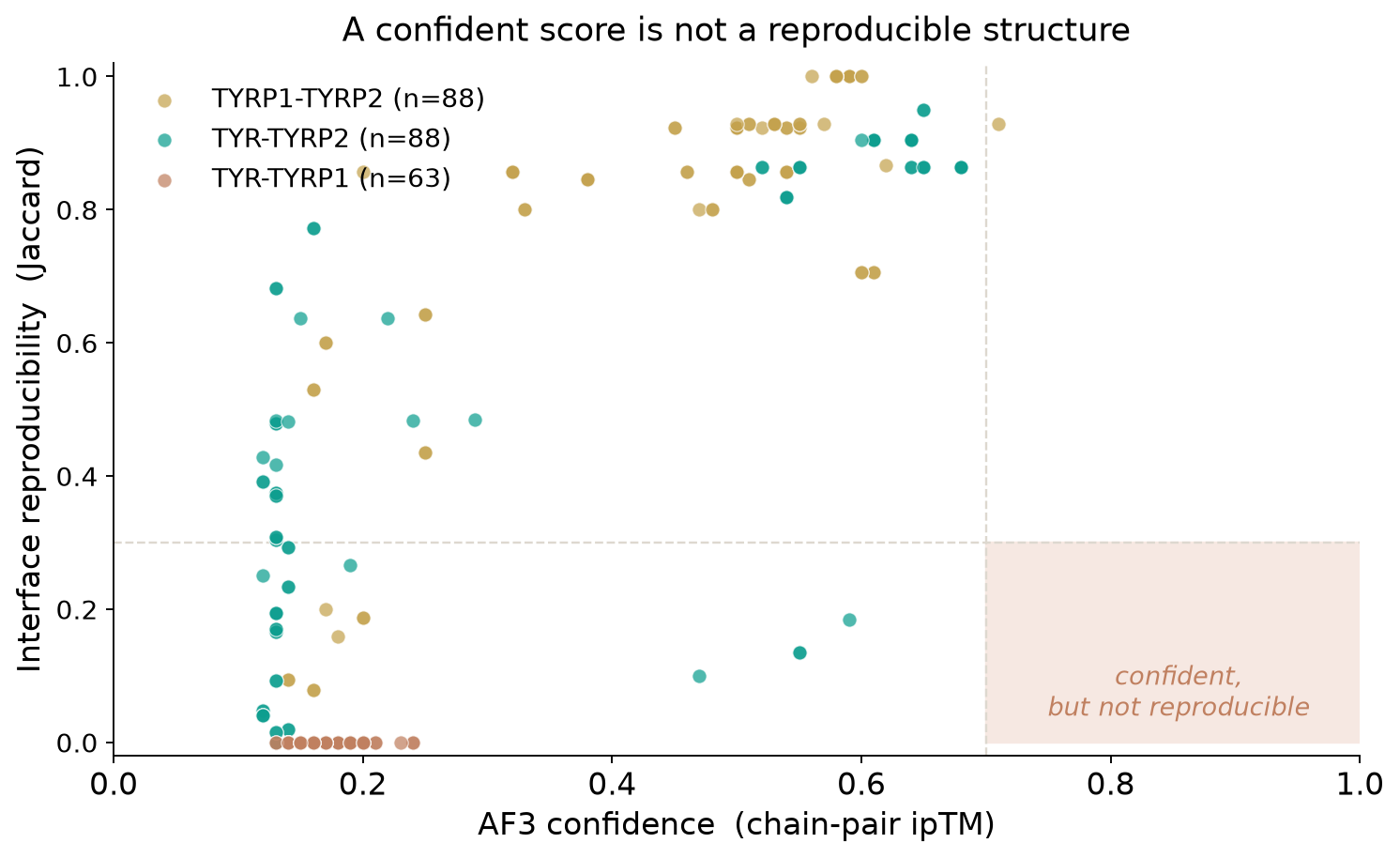
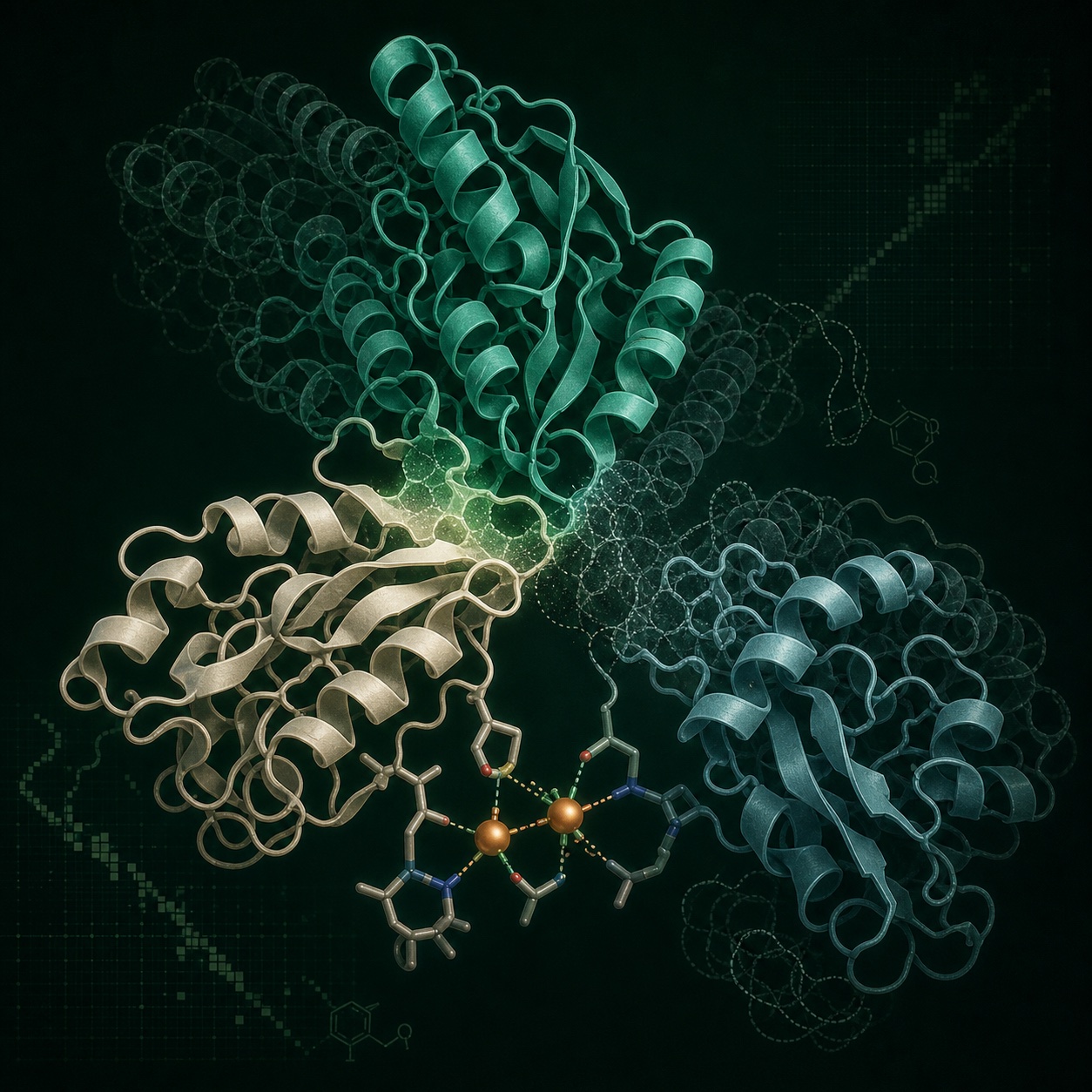
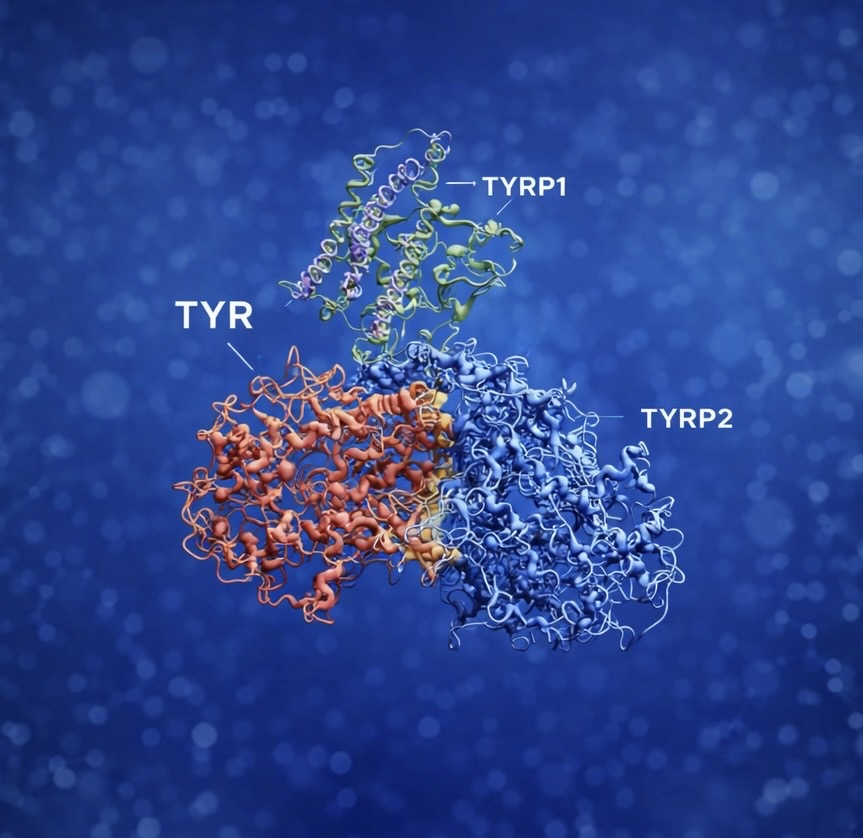
AlphaFold 3 proposes a protein assembly in seconds, but each prediction remains a hypothesis. We stress-test repeated-seed models where chemistry can change the answer: protein interfaces, metal sites, glycans, cofactors, and assembly state. The TYR-TYRP1-TYRP2 melanogenic system gives us a biologically important test case connected to pigmentation and albinism.
The predicted TYR-TYRP1-TYRP2 melanogenic trimer (AlphaFold 3). Open the dedicated video page →Each point is one model run. Confidence and reproducibility answer different questions, so interface hypotheses are evaluated across matched runs and against appropriate structural controls.
Enzyme mechanism · Histamine biology
What in your diet blocks histamine breakdown?
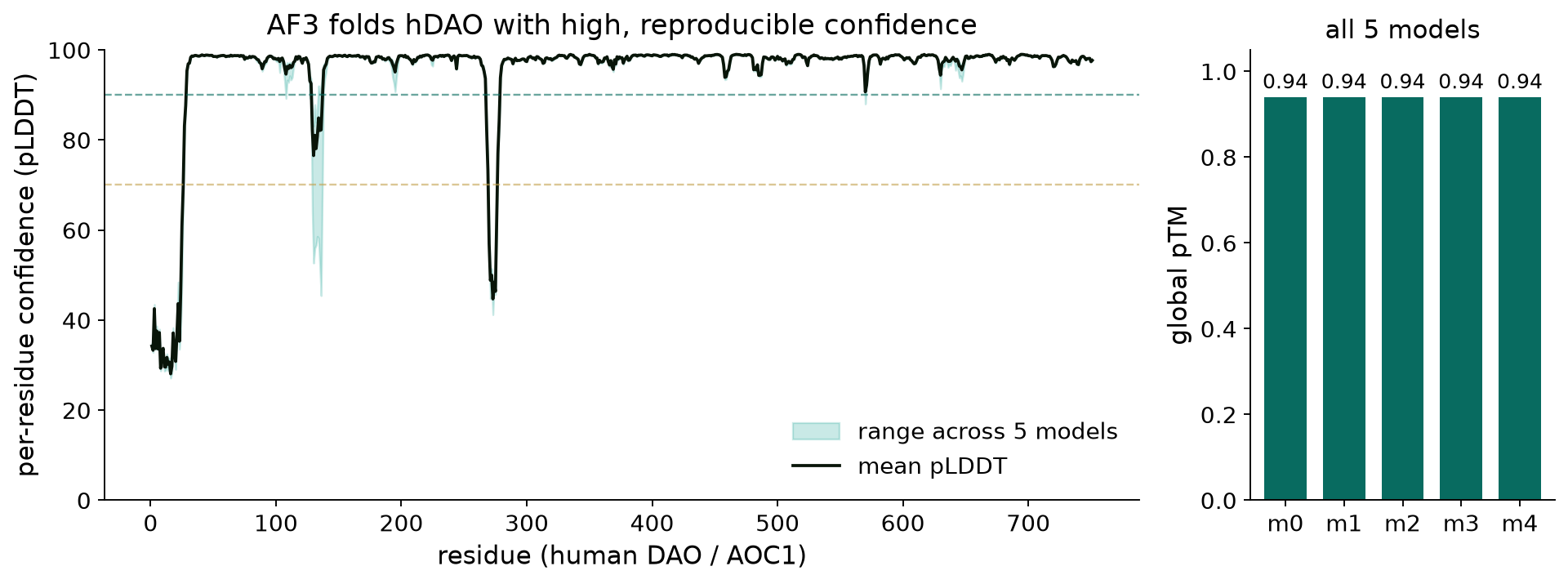
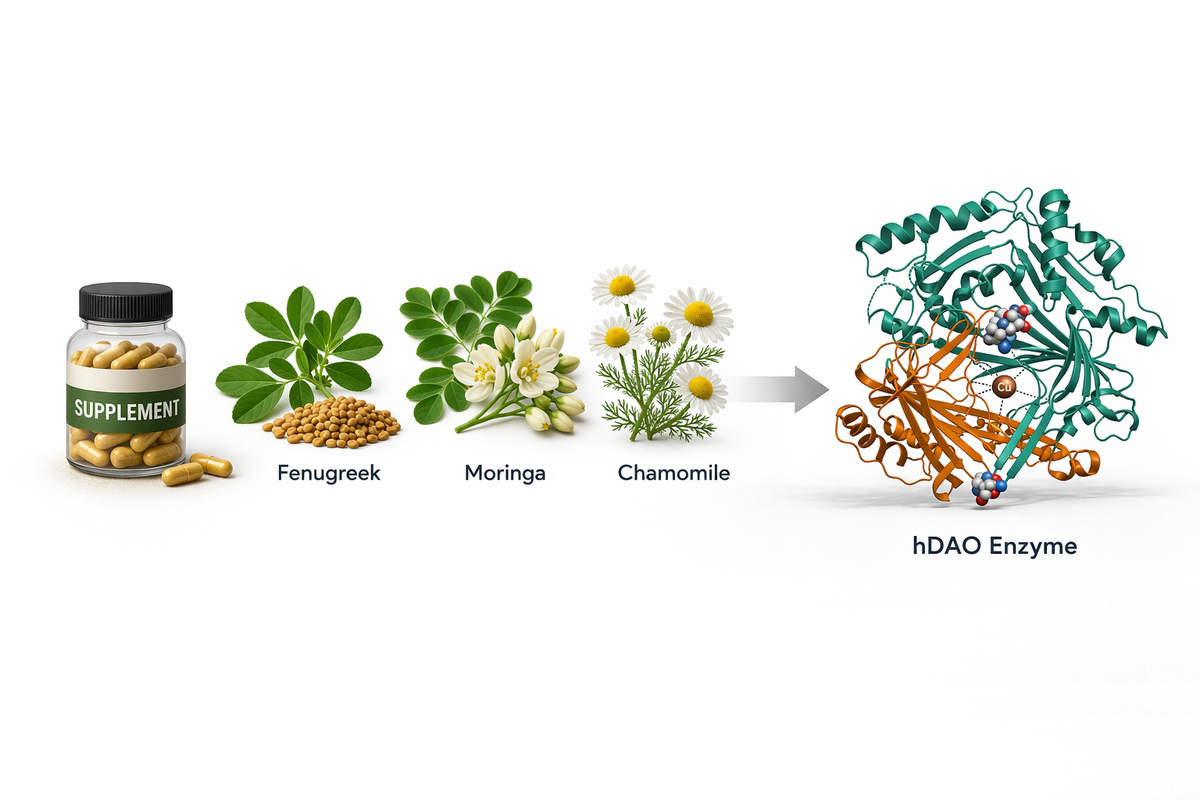
Human diamine oxidase (hDAO / AOC1) contributes to extracellular histamine and diamine clearance. We use structure prediction, identity-audited ligand preparation, and docking controls to prioritize supplement-derived compounds for bounded biochemical testing. Experimental activity and stability measurements provide the next validation layer.
A consistent, high-confidence AF3 fold of hDAO across five models, used as a receptor hypothesis for control-calibrated docking.
Protein design · ML for structure
A grammar of protein stabilization.
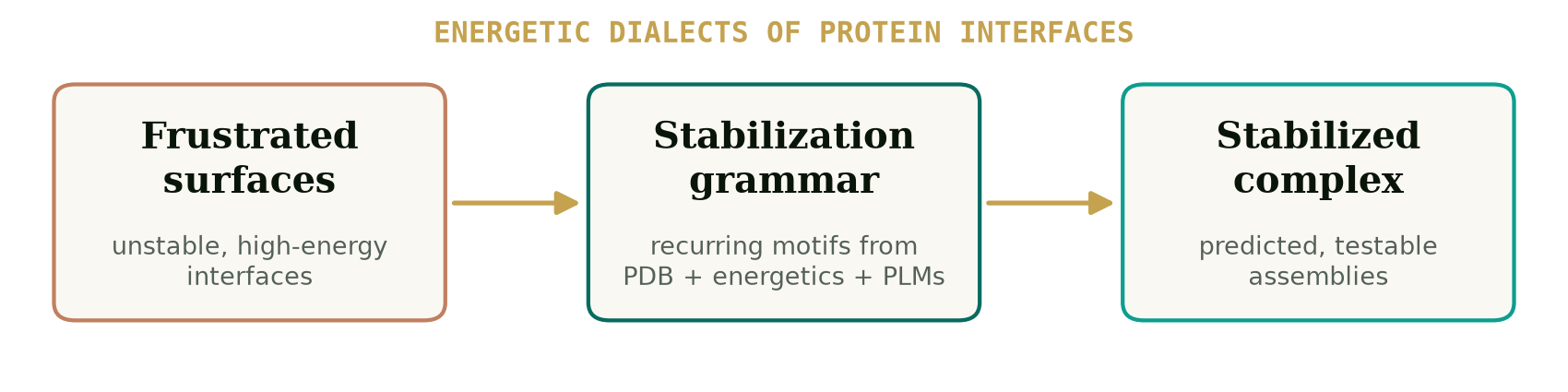
Some protein surfaces are strained and unstable; others lock cleanly into complexes. We are looking for the reusable rules that separate the two: a grammar of stabilization drawn from PDB structures, binding energetics, and protein language models. If those rules transfer, they tell us which proteins will pair stably, and why.
Biocatalysis · Green chemistry
Cleaner ways to oxidize stubborn hydrocarbons.
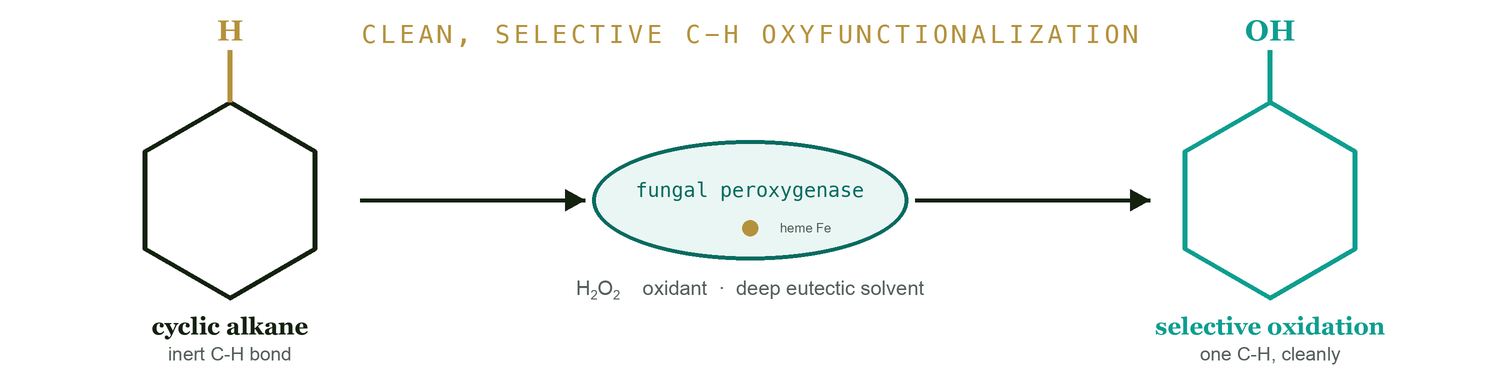
How do enzymes selectively oxidize some of the most inert hydrocarbons, and can they do it in greener solvents? We study fungal peroxygenases and their active-site chemistry for selective C-H oxyfunctionalization of branched and cyclic alkanes in deep eutectic solvents, with an eye toward cleaner chemical manufacturing.
One inert C-H bond, selectively oxidized under mild, greener conditions: hydrogen peroxide as the oxidant, a deep eutectic solvent as the medium.
Team
The people doing the work.
Undergraduate researchers at Stern College for Women carry the core of this work, co-mentored by MS Biotechnology graduate researchers in a near-peer structure. Contributions are documented, reviewed, and credited according to the standards of each scholarly output.
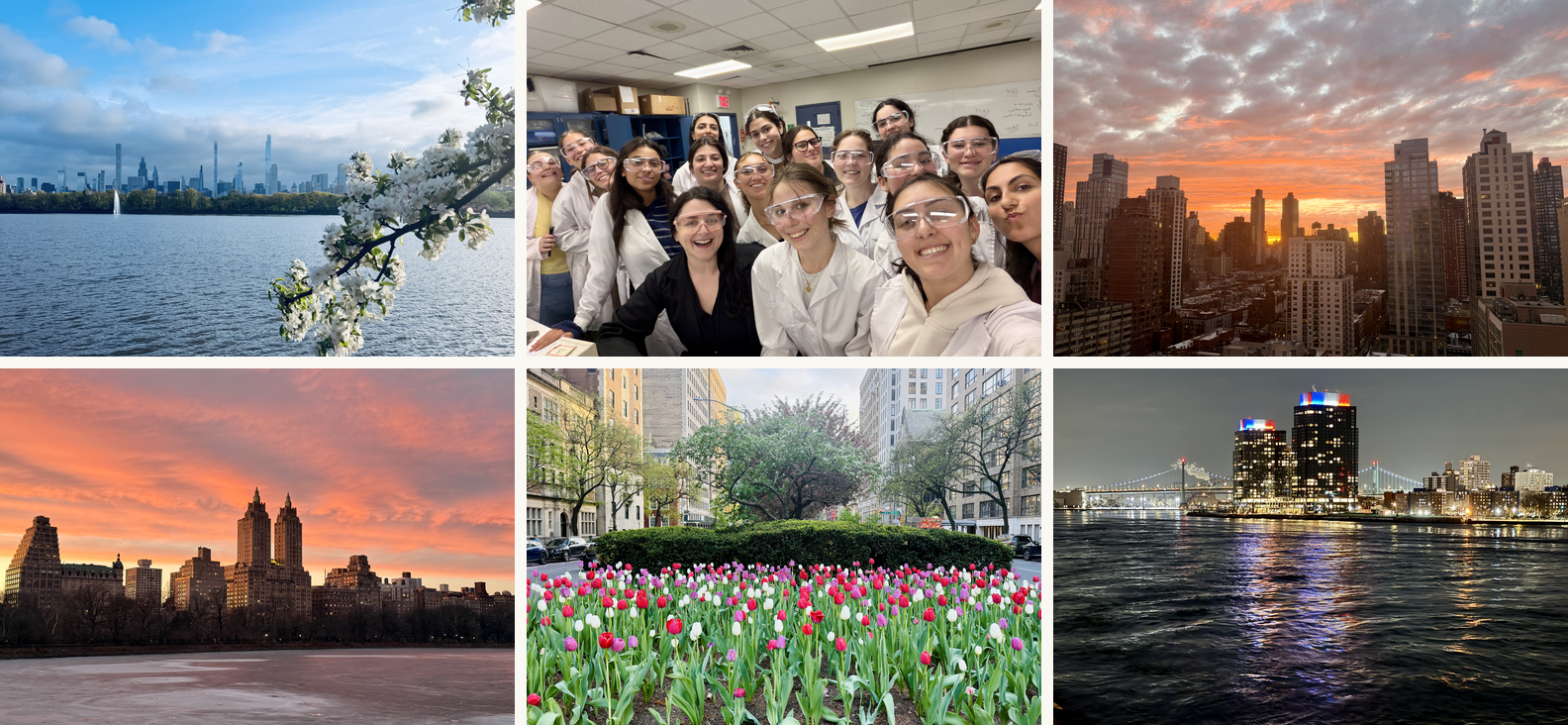
Based in New York City, the lab works across the classroom, the server, and the bench.
Olga Lavinda, PhD · Principal Investigator
Scientific direction, validation-framework design, and student supervision. ACS faculty mentor, Yeshiva University student chapter.
Graduate researchers · MS Biotechnology, Katz School
Undergraduate researchers · Stern College for Women
Tiferet Aharon · Netanya Cohen · Dalit Gulkarov
Apply to the lab →New undergraduate and graduate researchers join the lab each term.
Methods
Computational and experimental methods
The lab evaluates structure-prediction hypotheses across repeated runs and examines metal sites, glycans, cofactors, protein interfaces, and energetic controls. Experimental measurements are used where available to test specific biochemical predictions.
Students can arrive with no computational background and learn to carry a defined research question from the literature through analysis, evidence review, and scientific communication. The program is run as a documented system, reflecting the same operational discipline that defines the science.
A documented system
Seven skill-gated phases, a training manual, an individual notebook for every student, and mentor sign-off at each step.
Rigorous AI literacy
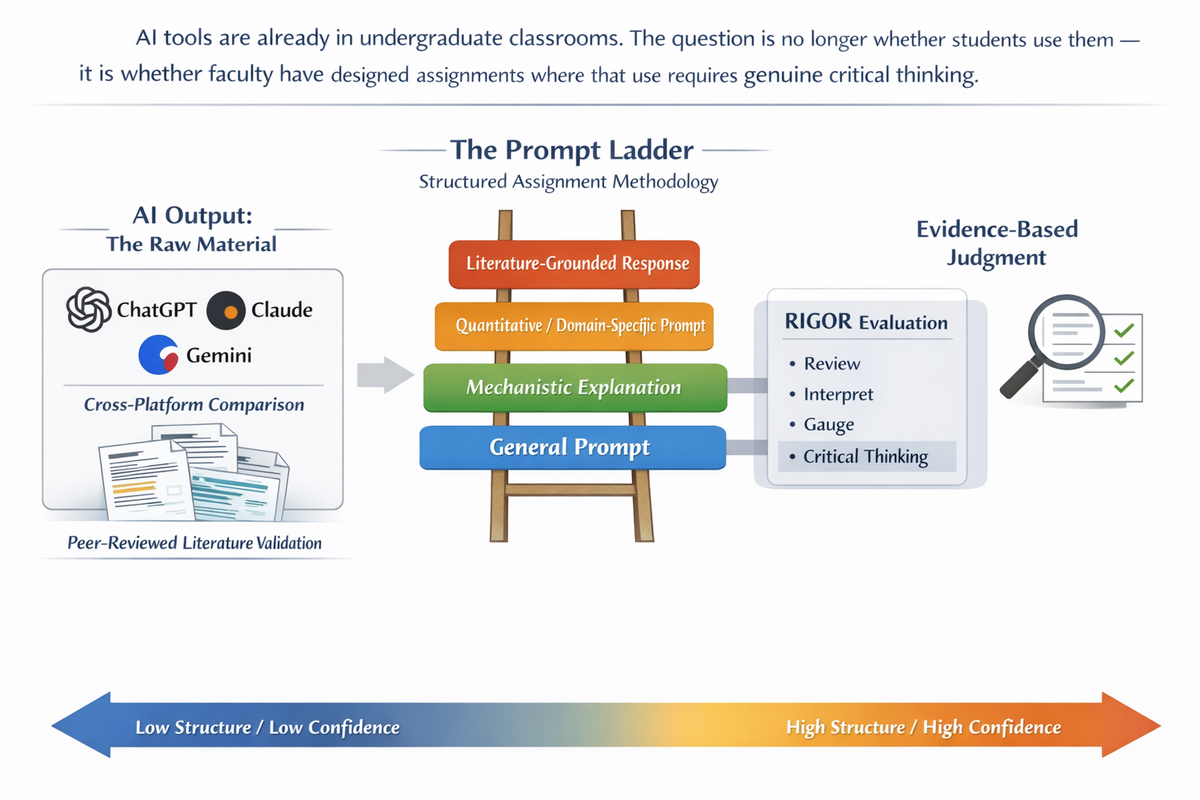
Students are taught to use AI as the field now requires: with prompt discipline, blinded scoring, and results stated no more strongly than the evidence supports. The approach has been presented at ACS.
Contribution-based credit
Student contributions are documented. Authorship and presentation credit follow the contribution standards of the relevant field and output.
The seven phases · each builds a specific, transferable skill
01
Background & framing
Literature · biology
02
Structure & sequence acquisition
PDB · UniProt
03
Visualization & validation
PyMOL · ChimeraX
04
Quality assessment
MolProbity
05
AI structure prediction
AlphaFold 3
06
Interface & reproducibility analysis
Python · pandas
07
Figures & communication
Matplotlib · poster design
+
Advanced tracks
AutoDock Vina · enzyme kinetics
Undergraduate and graduate researchers welcome. No prior computational-biology experience required.
The lab combines access, training, and scientific controls. A 25-seat Claude Team for Scientists environment supports supervised research and AI-literacy work, while the Research Cockpit captures artifacts, surfaces missing evidence, and routes scientific judgment to the PI.
25-seat research environment
Shared Claude Team for Scientists access supports structured lab training and research workflows.
Research Cockpit
Prediction outputs, notebooks, figures, and audit flags are organized into reviewable evidence panels with explicit provenance.
NYC Science Partnership Ecosystem
In development: a cross-institutional framework connecting educators, researchers, students, and responsible-AI practitioners around applied AI literacy and AI-for-science projects. Prospective institutional collaborators can connect through Olga Lavinda's engagement page.
Presentations
ACS Fall 2026
The lab presented three posters at ACS Fall 2026 across structural biology, medicinal chemistry, and AI literacy. Tiferet Aharon presented the TYR-family project, received an ACS Conference Travel Award, and participated in the Committee on Science Innovative Program.
InvitedCommittee on Science
Deep Learning Co-Folding versus Physics-Based Models of Protein-Ligand Interactions
COMSCI Innovative Program · ACS Fall 2026
Selected · Sci-MixChemical Education
Teaching with AI Without Losing the Student
A validation-first framework for AI literacy in undergraduate chemistry · CHED / Sci-Mix